Travel Agency vs. Private Tour Operator: The Real Difference
Travel Agency vs. Private Tour Operator: The Real Difference
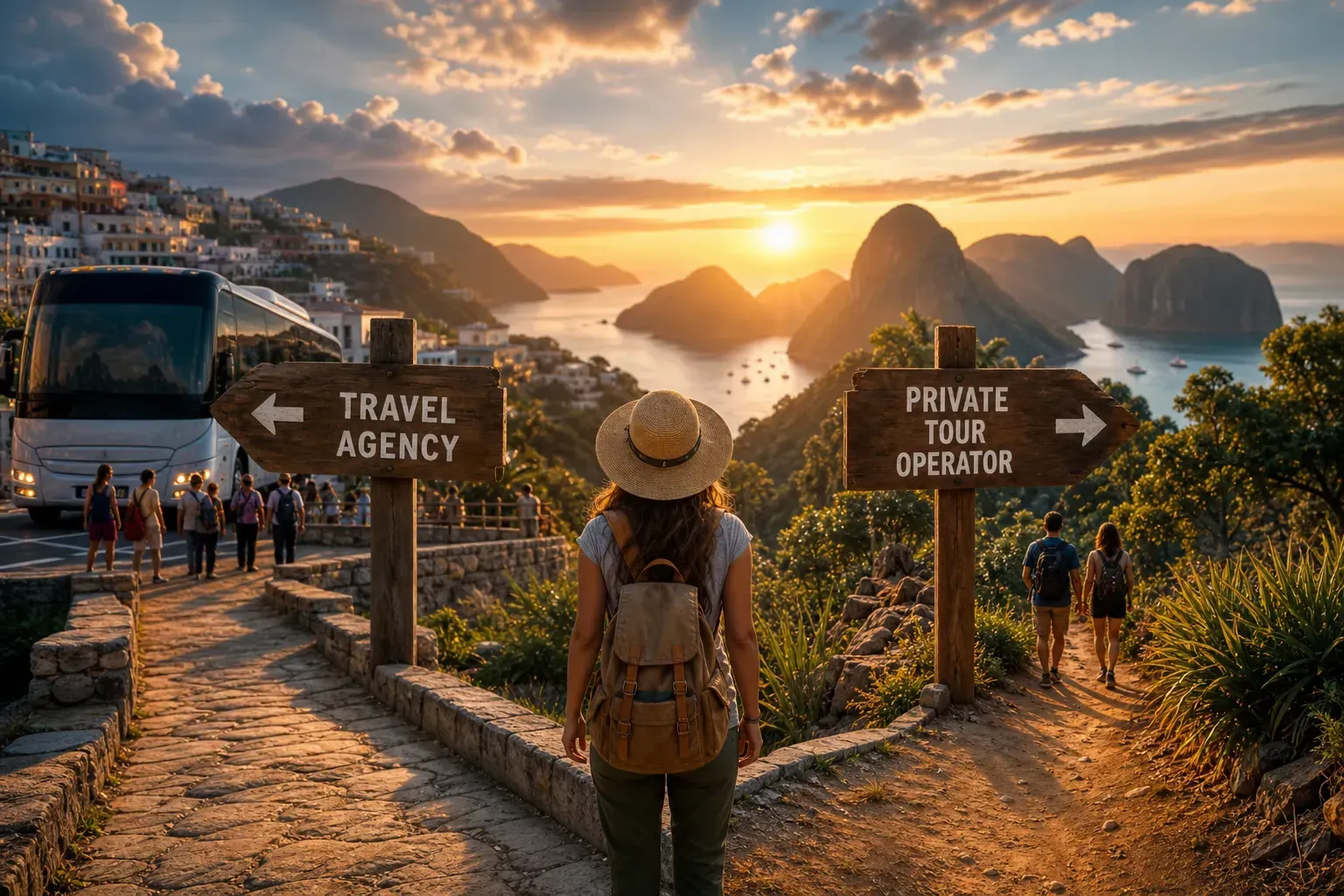
Picture two travelers both searching for the same thing: a fully custom two-week trip to Sicily built around wine, food, and coastline. The first contacts a travel agency and receives a glossy brochure of pre-set departures with fixed hotels and group schedules. The second contacts Contessa, and before anything is built at all, the team asks before it builds anything: your pace, your priorities, your food preferences, whether you're celebrating something, what kind of hotel makes you exhale when you walk in. Same destination. Completely different model.
The confusion between what a travel agency does versus what a private tour operator actually builds is one of the most persistent blind spots in trip planning. These two businesses look similar from the outside: both have websites, both handle bookings, both call themselves travel experts.
But they operate in fundamentally different ways, charge differently, carry different accountability, and deliver different results. Knowing the distinction before you book can be the difference between a trip that feels crafted for you and one that simply feels assembled.
What a travel agency actually does
A travel agency is a retail intermediary. It sells travel products built by someone else. The agency does not own the inventory it sells: it earns commissions paid by suppliers (hotels, airlines, tour operators) or charges a service fee, and its core job is coordination and booking, not creation. Think of it less like a designer and more like a very well-connected store.
The intermediary model, explained
When you book a packaged tour through a travel agency, the tour operator designed and built that product; the agency sold it to you. That distinction carries legal weight. Under EU law, and in Italy under art. 42 of the Codice del Turismo, the organiser of a package is answerable for how the package performs, whichever hotel, guide or driver delivers each piece of it. The shop that sold it answers for its own duties: booking accuracy, the information it gave you, your payment, not for the trip itself.
So when something goes wrong at the hotel, the agency's usual role is to relay the problem to the party who built the trip. That is a longer chain at the moment you least want one.
What "selling pre-packaged tours" really means
Most travel agencies sell from a catalog of existing products. These packages are standardized: fixed departure dates, fixed hotels, fixed group sizes, fixed sequence of days. There is limited room to modify them because the agency doesn't control the components. That works efficiently for straightforward travel, but it creates real friction when your trip requires something specific. You can't ask a brochure to reroute your day because you want to spend three hours at a winery instead of one.
How private tour operators build trips differently
A private tour operator functions more like a producer than a reseller. Instead of distributing a finished product, the operator designs and assembles the itinerary from scratch, contracting directly with local hotels, guides, drivers, and experience providers. The operator takes on commercial responsibility for the entire journey. One entity built it, one entity is accountable for it, and one entity is invested in making it work.
The inbound versus outbound difference matters here. An outbound agency books travel away from your home country. An inbound or destination-based operator manages the experience on the ground in the destination itself. Ground-level presence determines what quality of access, care and problem-solving is realistically available to you while you are there.
Building the itinerary from the ground up
When a private tour company says "custom," that word carries real operational weight. The process starts with the traveler's interests, pace, dates, and preferences, and then builds a sequence of components that serves those specific needs. Nothing is templated. Every hotel is chosen for a deliberate reason. Every guide is vetted directly by the operator, not pulled from a generic list. The itinerary that emerges is something that did not exist before you reached out.
What direct local relationships unlock
A destination management company or inbound tour operator has supplier agreements and personal trust built over years of working in a specific place. That's what opens the winery that doesn't do public tastings, the table at the restaurant that stopped taking reservations two years ago, the boat that isn't listed on any booking platform. These aren't perks bolted onto a standard tour; they're the natural result of a local team with genuine relationships and genuine accountability to the people they work with every day.
Bespoke vs. template: what the traveler actually experiences
A packaged tour groups you with strangers, follows a fixed schedule, and cannot adapt when you want to linger over lunch or skip an afternoon museum in favor of a beach. A private journey moves at your pace. It shifts when plans change. And it has a local team that is personally invested in whether you're happy, not just whether you showed up at the right bus.
Daily support and what real on-the-ground care looks like
Contessa's team checks in with travelers every single day of the trip to confirm everything is running to standard, address any requests, and adjust where needed. That level of active, real-time support is not something an intermediary can offer, because the agency is not present in the destination. An operator based in the destination can act on the day. One working remotely can only relay.
What you are paying for, and what the number can do after you sign
A package sold through a chain of intermediaries reaches you as one retail figure. Part of it pays for the hotel, the guide and the driver. Part of it pays for the chain that put the brochure in front of you. You are not shown the split, and there is no particular reason you should expect to be.
Book with the company that organises the trip and the split changes: fewer parties are paid, and more of the money sits in the things you will stand in front of — the room with the terrace rather than the one facing the car park, four hours with the guide instead of two, the driver who waits.
The second difference is legal rather than commercial. Contessa is a licensed Italian travel organiser (authorisation D.D.S. 3662/S7), so the Codice del Turismo governs how we quote you. Before you sign, we are required to state the total price, what is included, the payment schedule, cancellation terms and insolvency protection, and that information becomes part of the contract.
Even where a price adjustment is legally permitted, an increase above 8% gives you the right to accept the change or terminate the contract without a cancellation fee. A cost we failed to disclose before you signed is a cost we cannot simply add later.
So the question worth putting to any operator, us included, is what the number includes and what it is allowed to do between today and your arrival.
How to vet a tour operator or travel agency before booking
Regardless of which model you're choosing, there is a short set of questions you should run through before committing. A credible private tour company answers all of them without hesitation and puts the answers in writing. If any of them produce deflection or delay, that is useful information.
Questions worth asking before you commit
Start with the structural questions:
- Are you the direct operator or a broker?
- Can I see the full itinerary with what's included and what's not included?
- What are the exact cancellation and refund terms?
- What insurance do you carry?
- Who is my 24-hour contact on the ground during the trip?
These are not aggressive questions. They are basic questions that every legitimate operator handles routinely.
Red flags that signal a problem
Watch for these warning signs:
- Vague "similar hotel" or "equivalent property" language instead of confirmed, named bookings
- No physical address, no registered company name, or contact only via WhatsApp or personal email
- Pressure to pay quickly, prices far below market with no explanation, or requests for wire transfers or crypto
- Reviews that exist only on the company's own website with no independent third-party footprint
- Refusal to put cancellation terms, inclusions, or emergency procedures in writing
If the operator deflects on any of the basic vetting questions, that's the answer. A company that can't tell you who your guide is or what happens if your flight is delayed is not set up to take care of you when it matters.
Which one is right for your trip? Depends on what the trip actually requires
Neither model is universally better. The right choice depends on what the trip actually requires
When a travel agency fits well
A travel agency makes sense when you want broad destination choice, are booking relatively straightforward components like flights and hotel nights, and don't need a deeply customized experience. For standard leisure travel where flexibility to mix and match matters more than a single curated vision, an agency works efficiently and well. There's no reason to overcomplicate a simple booking.
When a private tour operator is worth it
A private tour operator earns its fee when the trip requires specific expertise, local relationships, or real personalization. Complex multi-stop itineraries, milestone celebrations, food and wine deep-dives, first-time visits to specific regions: these are the situations where having one accountable local expert, not a broker, makes a material difference. When something going wrong would be genuinely costly to your trip or your memory of it, the case for a destination-based operator who knows the ground is not just strong. It's straightforward.
One sells, one builds
That's the clearest way to hold the distinction. A travel agency sells travel services. A private tour operator builds the experience. For travelers who want more than a pre-packaged itinerary, who want something that was designed with them specifically in mind, a private operator with genuine roots in the destination is worth the investment.
Contessa exists precisely as that kind of company in Sicily. A small, locally embedded team physically based on the island, with personal relationships with winemakers, guides, boutique properties, and boat operators that cannot be replicated from a booking platform or a brochure. Every itinerary begins with a conversation, not a catalog.
If you're planning a tailor-made journey to Sicily and want to understand what is the difference between a travel agency and a private tour operator for your trip, reach out and start one. There are no packages waiting to be sent your way, only questions worth asking.
Recent Posts
